
National Museum of Ireland – Archaeology
The National Museum of Ireland – Archaeology is the national repository for all archaeological objects found in Ireland and home to over two million artefacts.
The National Museum of Ireland was founded under the Dublin Science and Art Museum Act of 1877. Previously, the Museum’s collections had been divided between Leinster House, originally the headquarters of the Royal Dublin Society, and the Natural History Museum in Merrion Street, built as an extension to Leinster House in 1856 – 1857. Under the Act, the government purchased the museum buildings and collections. To provide storage and display space for the Leinster House collections, the government quickly implemented plans to construct a new, custom-built museum on Kildare Street and on 29 August 1890, the new museum opened its doors to the public.
The building, designed by Cork architects Thomas Newenham Deane and his son Thomas Manly Deane, is an architectural landmark. It is built in the Victorian Palladian style and has been compared with the Altes Museum in Berlin, designed by Karl Schinkel in the 1820s. Neo-classical influences can be seen in the colonnaded entrance and the domed rotunda, which rises to a height of 20 metres and is modelled on the Pantheon in Rome. Within the rotunda, classical columns – made of marble quarried in Counties Cork, Kilkenny, Galway, Limerick and Armagh – mirror the entrance. In the great centre court, a balcony is supported by rows of slender cast-iron columns with elaborate capitals and bases decorated with groups of cherubs. On the balcony, further rows of plain columns and attractive openwork spandrels support the roof.
The interior is richly decorated with motifs that recall the civilisations of ancient Greece and Rome. Splendid mosaic floors depict scenes from classical mythology, of which the zodiac design in the rotunda is especially popular with visitors. Particularly lavish are the majolica fireplaces and door surrounds manufactured by Burmantofts Pottery of Leeds, England, and the richly carved wooden doors by William Milligan of Dublin and Carlo Cambi of Siena, Italy.
Permanent exhibitions
Kingship & Sacrifice – An exhibition of bog bodies and related finds
The exhibition is centred on findings of the National Museum of Ireland’s Bog Bodies Research Project. Following the discoveries of Iron Age bog bodies at Oldcroghan, Co. Offaly and Clonycavan, Co. Meath in 2003, a team of international specialists worked with Irish Antiquities and the Conservation Department of the National Museum to examine these human remains. Now a major exhibition gives an overview of the results of the analysis and, along with other bog bodies from the collections of the National Museum, offers an opportunity to literally come ‘face to face’ with the past. The exhibition also highlights a theory based on the observation that the bog bodies were placed on significant boundaries linking them with sovereignty and kingship rituals during the Iron Age. Research also indicates that other related material is connected with inauguration rituals of kings and that these rituals can be traced back to the Bronze Age. Many of these objects, such as kingly regalia, horse trappings, weapons, feasting utensils, textiles and boundary markers are on display.
This is a permanent exhibition
Life & Death in the Roman World
This exhibition features objects that have been in storage in the National Museum of Ireland since the early 1920s. The objects were collected primarily in the nineteenth and early twentieth centuries not just for public display but also to assist scholars in the study of classical art and architecture. The collection includes glass vessels, textiles, sculpture, ceramics, coins, gemstones and architectural fragments from places as geographically diverse as Egypt, Austria and England.
This is a permanent exhibition
Rites of Passage at Tara: The Excavation of the Mound of Hostages
The Hill of Tara is, perhaps, the best-known complex of archaeological monuments in Ireland. Because of its associations with the High Kings of Ireland, and its international recognition, Professor Seán P. Ó Ríordáin’s excavations at Tara in the 1950s attracted great interest.
This exhibition displays some of the many exceptional finds found during the excavation and describes some aspects of its cultural setting in the Neolithic and Bronze age periods.
This is a permanent exhibition
Prehistoric Ireland
This exhibition documents human settlement in Ireland from the stone tools of the first hunter-gatherers around 7,000 BC to the bronze weapons of the Later Bronze Age around 500BC. A reconstructed Passage Tomb provides a backdrop to the tools, pottery and personal objects of the Neolithic farmers, including a beautifully decorated flint mace head from Knowth, Co. Meath.
The introduction of metalworking around 2,500 BC and its development are documented. Copper axes and daggers, shields, cauldrons and cast bronze horns (the earliest known Irish musical instruments) are displayed. The exhibition also contains jewellery made from amber, glass and stone as well as wooden examples of shields, wheels and cauldrons. Prominently displayed is a 4500-year-old logboat from Lurgan, Co. Galway – one of the largest vessels of its type to have been found in Ireland.
This is a permanent exhibition
Ór – Ireland’s Gold
The National Museum’s collection of prehistoric goldwork, ranging in date between 2200BC and 500BC, is one of the largest and most important in Western Europe. Most are pieces of jewellery but the precise function of some is unknown.
During the Early Bronze Age the principal products were made from sheet gold, and include sundiscs and the crescentic gold collars called lunulae. Around 1200 BC new gold working techniques were developed. A great variety of torcs was made by twisting bars or strips of gold.
Styles changed again around 900 BC and the gold-work of this period can be divided into two main types. Solid objects such as bracelets and dress-fasteners contrast dramatically with large sheet gold collars and delicate ear-spools.
This is a permanent exhibition
The Treasury
Inspired by the great church treasuries of medieval Europe, this exhibition houses outstanding religious and secular metalwork dating from the pagan Celtic Iron Age through to the Middle Ages. Objects include the sumptuously ornamented Broighter gold collar, found with other neck ornaments and intriguing models of a boat and a cauldron. The Broighter collar is decorated in the La Tène art style introduced from the continent as is the great bronze trumpet from Loughnashade, Co. Armagh.
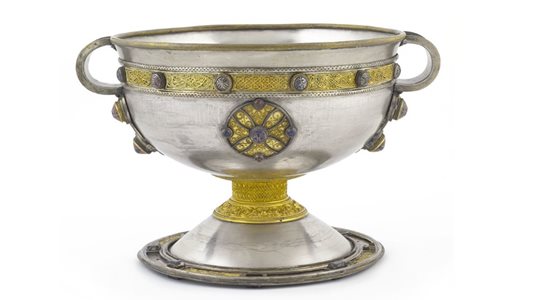
Pride of place is given to some of the best-known treasures of the 8th-9th century ‘Golden Age’ such as the Ardagh and Derrynaflan Hoards, the Moylough Belt Shrine and the gilt silver Tara Brooch, remarkable for the sumptuousness and variety of its decoration and the detail and quality of its workmanship.
Hoards or silver bullion and brooches, bracelets and other personal ornaments illustrate the impact of the Vikings. A selection of crosiers and the elaborate Shrine of St. Patrick’s Bell are illustrative of the new styles and trends of the succeeding Romanesque period.
This is a permanent exhibition
Viking Ireland
This exhibition documents the Viking Age in Ireland from c.800 AD to c.1150 AD. The first contacts between the Vikings and Ireland are evident in material found in Viking graves of the 9th and 10th centuries from Ireland. Finds from Irish settlement sites of the 9th and 10th centuries illustrate rural life, and a selection of silver ornaments indicates the wealth of Scandinavian and Irish settlements of this period.
At the centre of the exhibition is a display of finds from the National Museum’s Dublin excavations, carried out between 1962 and 1981. This represents the finest collection of excavation finds from an early medieval urban centre anywhere in Europe.
A final section displays ecclesiastical metalwork of the 11th and 12th centuries, which shows the fusion of Scandinavian and Irish art styles at the close of the Viking Age.
This is a permanent exhibition
Medieval Ireland 1150 – 1550
The exhibition contains three galleries entitled Power, Work and Prayer, reflecting the three-fold division of medieval society – nobles, common people and clergy.
The lifestyle of nobles is explored while surviving arms and armour reflect the distinctive characteristics of warfare in medieval Ireland.
The exhibition looks at the different forms of agriculture, pastoral and arable, which were practiced. Finds from urban excavations illustrate Ireland’s import trade and the various crafts and industries operating in towns.
The Irish church changed fundamentally in the 12th century, although many older church traditions survived. The exhibition also looks at religious practice and devotion as well as church furnishings, including a fine selection of late medieval reliquaries: Book Shrines, Bell Shrines and Croziers.
This is a permanent exhibition
Ancient Egypt
The National Museum of Ireland’s Egyptian collection comprises about 3000 objects, the majority acquired from excavations carried out in Egypt between the 1890s and the 1920s and ranging in date from the Stone Age to the Middle Ages.
During the late 19th century the National Museum received a share in several major divisions of finds from the excavations of the Egypt Exploration Fund, London including sites such as Hieraconpolis, Deir el-Bahri, Ehnasya, Oxyrhynchus, Tarkhan and Riqqa. The exhibition includes finds collected by Irish travellers such as Lady Harriet Kavanagh.
Amongst the most important objects exhibited are the gilt and painted cartonnage case of the mummy Tentdinebu dated to the 22nd Dynasty c. 945-716 BC, the mummy portraits of a woman and a young boy from Hawara dated to the 1st/2nd century AD and a model of a wooden boat dated to the early 12th Dynasty c 1900 BC. There are a number of important stelae, tomb furniture, offering tables, jewellery and household equipment.
A CD-ROM devoted to the Egyptian collection of the National Museum of Ireland is available. For more information see www.ccer.nl.
This is a permanent exhibition
Ceramics & Glass from Ancient Cyprus
This exhibition focuses on Cypriot artefacts in the collection of the National Museum of Ireland, many of which have never been exhibited before. Most of the pieces are ceramic and probably come from tombs uncovered in the 19th Century. The artefacts range in date from the Bronze Age, approximately 2500 BC, to the late Roman period, about 300 AD, and are arranged chronologically. The exhibition also includes five clay figurines on loan from The Cyprus Museum, Nicosia.
The variety of styles and decoration visible in the artefacts from each period illustrates the unique blend of cultural influences that characterises the archaeology of Cyprus.
This is a unique opportunity to learn about a historic collection of beautiful ceramics and glass from Cyprus at the National Museum of Ireland.
This is a permanent exhibition
Dublin 2
Monday 13:00 - 17:00
Tuesday 10:00 - 17:00
Wednesday 10:00 - 17:00
Thursday 10:00 - 17:00
Friday 10:00 - 17:00
Saturday 10:00 - 17:00
Sunday 13:00 - 17:00