
Susan MacWilliam: Table Turning
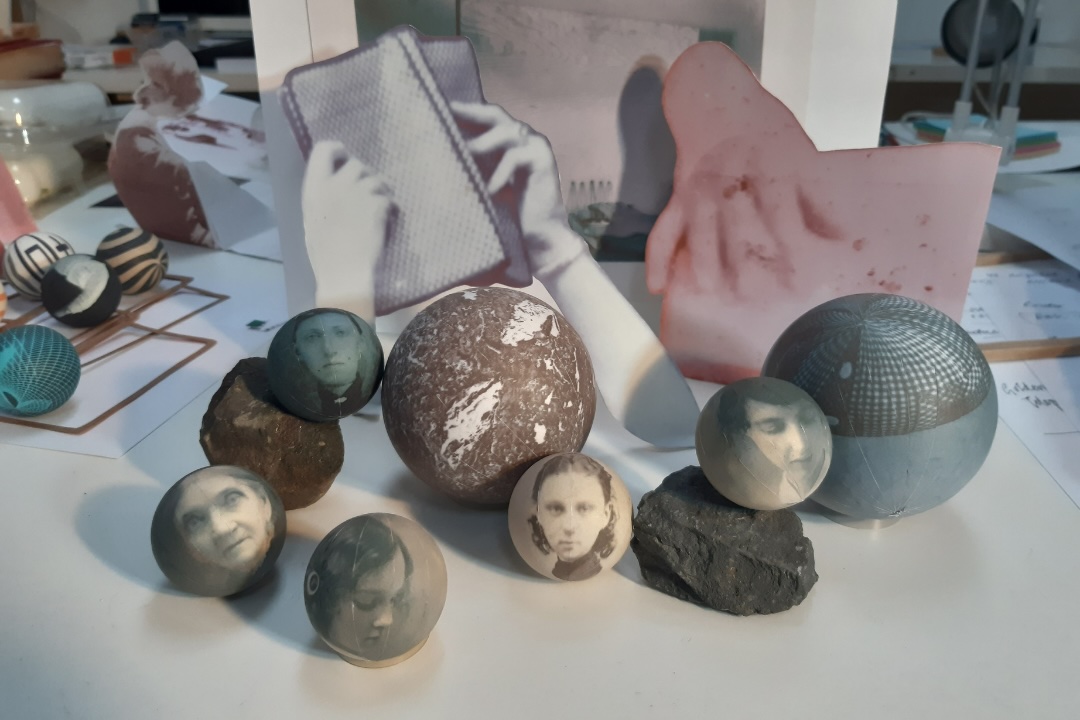
Over the past three decades, Susan MacWilliam has created a singular body of work. She draws from printed archives, scientific apparatus, and interviews with experts to explore the field of psychical research.¹ In this way she addresses phenomena contested by orthodox science such as clairvoyance, telepathy, and precognition.
On Saturday, 21 February at 3pm, artist Susan MacWilliam will join us to mark the closing of her solo exhibition Table Turning. MacWilliam will be in conversation with Jacqui McIntosh, curator at the College of Psychic Studies, where MacWilliam’s work can also presently be seen as part of The Medium is the Message.
In 1997 MacWilliam happened upon a TV documentary about spirit mediums. She found the imagery and choreography of the séance room featured in the programme intriguing.² There began an ongoing fascination with how humans have sought to document and quantify the spirit realm.³
The title of this exhibition refers to a practice widespread in the late-nineteenth century and held up as evidence of psychic phenomena. Small groups would sit in circles around tables and would, through spiritual influence or subterfuge, make them tilt, rotate, or levitate in ways that contradicted the laws of physics.
Occurrences such as this were common in the house of Dr. T. G. and Lillian Hamilton, who led investigations of psychic phenomena in their home in Winnipeg, Canada between 1918 and 1945. The Hamiltons conducted their experiments in a room with conditions thought to be conducive to spirit activity. Photographs taken in this environment have entered the canon of paranormal photography. For Séance Room, 1931 (2025), MacWilliam has hand-stitched the diagram of the provisional laboratory devised by the Hamiltons.⁴
MacWilliam sheds light upon the gendered relations of mediumship in the late-nineteenth and early-twentieth century. In many cases, mediums were female, while those ‘investigating’ them were predominantly men. Mediumship could provide women with status and a means of independent income. Victorian power relations between men and women could be disrupted, albeit via strategies that were literally otherworldly.
The independence of women is invoked in the vitrine sculpture The Three Arts Club (2025). The artwork is named after a twentieth-century group that supported young women in practising the ‘three arts’ of music, drama, and painting. Family letters from the 1920s reference MacWilliam’s great-aunt staying at the Three Arts Club, London.
The source image from a found postcard shows five women reading in a drawing room of books. MacWilliam imagines the book as a form of technology that allows intellectual exchange from one person to another, a metaphor for telepathy. Literacy gave women access to education and mobility, and reading was a facet of liberation. The book is a portal to knowledge and a means by which we navigate and make sense of the world. Motifs of books, hands, and visual references to the act of reading recur elsewhere in this exhibition.
The idiosyncratic interior of Ormston House has provided a catalyst for the creation of new sculptural elements. In particular, the oversized Corinthian capitals that dominate the gallery have informed modelled and cast pieces in which miniature hands hold books. This iconography is taken from Telepaths, MacWilliam’s collection of photographs and postcards featuring women reading. Some of these are displayed in a cabinet alongside historical books from the artist’s extensive library of psychical research.
The cast artworks in this exhibition recall funerary sculpture encountered by MacWilliam in Parisian cemeteries and are reminiscent of some of her earliest pieces. Their hand-hewn character evokes the expansive bas-relief plasticine works that featured in MacWilliam’s exhibition Curtains at Project Arts Centre, her first solo show in Dublin in 1997.
The exhibition Table Turning has emerged out of meticulous, manual processes: the cutting, stitching, sculpting, and moulding of paper, felt, and clay. The freedoms and surprises of the act of making produce unforeseen visual forms and vocabulary in response to the aesthetics and social implications of psychical research. For MacWilliam “the realisation of ideas and objects in the studio” is akin to “the manifestations and materialisations of the séance room”.⁵
¹ The study of psychic phenomena using scientific methods.
² Susan MacWilliam, ‘My Adventures in the Supernormal’, The Paranormal Review 59 (2011): 4.
³ The following year she made her first moving image work; The Last Person (1998) reflects on the case of Scottish medium Helen Duncan, the last person to be imprisoned under the British Witchcraft Act of 1735.
⁴ The room is the location of the appearance of the FLAMMARION teleplasm, the subject of MacWilliam’s film F-L-A-M-M-A-R-I-O-N, which was shown when she represented Northern Ireland at the 2009 Venice Biennale.
⁵ Susan MacWilliam and Slavka Sverakova, ‘Susan MacWilliam: Portraying a Worldview’, in Remote Viewing (London: Black Dog Press, 2008), 111.
In February, a talk will take place at Ormston House between Susan MacWilliam, Pádraic E. Moore, and Jacqui McIntosh.
An archivist and curator, McIntosh cares for the large collection of spirit-inspired art, photography, and artefacts at The College of Psychic Studies, London. Independently, McIntosh is a researcher, curator, and writer. Her research encompasses feminist, mediumistic, and esoteric histories, with a particular interest in artists whose spiritual development has evolved in tandem with their artistic output.
Details forthcoming via our website and social media.
Susan MacWilliam was born in Belfast in 1969 and works between Belfast and Dublin, where she is a lecturer in Fine Art at the National College of Art and Design. In 2009, MacWilliam represented Northern Ireland at the 53rd Venice Biennale. In 2016–17, her mid-career survey show Modern Experiments toured Ireland with exhibitions at F.E. McWilliam Gallery, Banbridge; Highlanes Gallery, Drogheda; Uillinn: West Cork Arts Centre, Skibbereen; and Butler Gallery, Kilkenny.
MacWilliam is currently exhibiting in Ghosts, curated by Eva Reifert at Kunstmuseum Basel (until 8 March 2026), and The Medium is the Message, curated by Jacqui McIntosh at The College of Psychic Studies, London (until 31 January 2026). She is represented by CONNERSMITH.
Table Turning is supported by The Arts Council of Ireland and Limerick Arts Office.
Limerick City