
Stephanie Deady: Emotional Calculus
Sienese painting of the Trecento and Quattrocentro is often exciting in ways that transcend the conventional view of Renaissance art as pursuing an arc of progress towards a mastery of perspective and a familiar naturalism. That arc prompted Samuel Beckett’s jibe about Renaissance artists looking at the world with the eyes of building contractors. By contrast, many Sienese painters particularly, including Simone Martini, the Lorenzetti brothers, Sassetta and others, opened up other kinds of pictorial space, more subjective, more spatially, narratively and temporally complex; more magical. Such qualities led eventually, in the 19th century, to a scholarly re-evaluation of Sienese painting as a distinct arena of invention, notably subtle, reflective, versatile and unpredictable.
Not surprisingly, painters, who had more or less known this all along, having discovered the possibilities of their medium by themselves, were in agreement. Stephanie Deady’s work has from the first concerned itself with just such complex pictorial spaces. Her early paintings appear not so much to depict as construct and reconstruct domestic interiors, seeing them not as structures and surfaces per se (with the eyes of a building contractor), but as settings dynamically formed and sustained by the human presence, and the relationships they reflect and symbolise. Not to suggest that the pictures are at all romanticised or blinkered. Their gaps and disjunctures are surely indicative of the fundamental precariousness of things, and of the work, including emotional work, involved in the daily business of living. In this they are alert to such eventualities as isolation and loss.
In her subsequent series Measure for Measure, the artist considers communal space and the happy chance of group rapport. The charged, heightened nature of a meeting between individuals in a Renaissance painting might derive from the ecclesiastical nature of the commission, a sense of the sacred, and Deady assigns a comparably hallowed character to the fortuitous confluence of people and energies momentarily pooled in effortless, communal harmony.
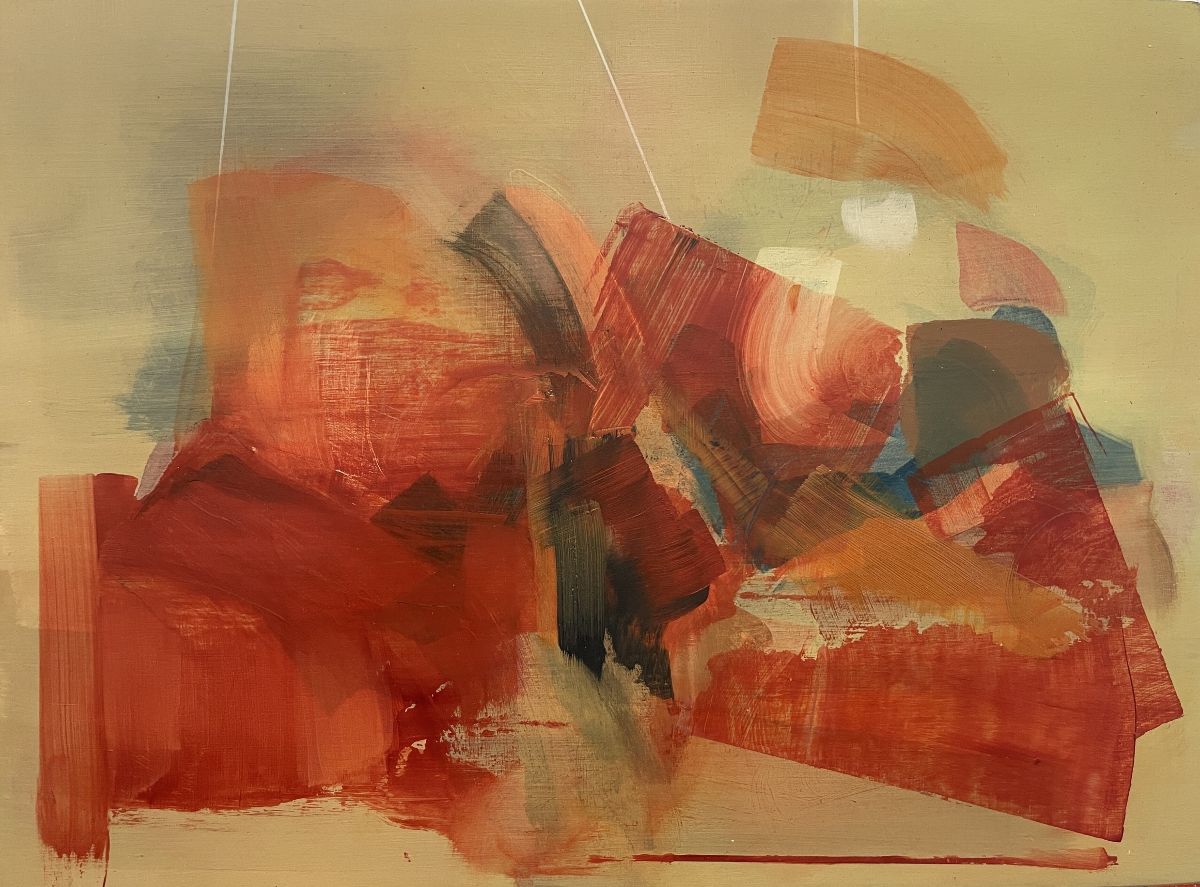
Her recent paintings prompt the thought that she again chooses to work outside the conventions of one-point perspective. She mentions an idea she had, in fact, of a kind of allover, aerial view, though in the event this was not a defining principle in the working process. It may be more helpful if we see the paintings as occupying a space free from the rules of naturalistic representation, somewhere apart, fusing inner and outer worlds, and allowing for a longer, considered view over time. The energies of the compositions are in most cases generated by two adjoining figures, and the way they create and are in turn shaped by the traffic of interaction between them. Powerful internal currents animate each of them, whole worlds of feeling. As with the Measure for Measure works, this entails a powerful intimation of bodily presence and action: a choreography of stance, attitude, movement, gesture, nuance – and vision. Colour, sparing yet intense, sets the temperature of the mood. Spatially, we are in a zone as expansive as a biblical desert in a Renaissance painting, and as abstract: a frame for thought and contemplation in which we try to orient ourselves.
Thrilling, quicksilver arrangements of fierce movement, Deady’s new paintings are also, and simultaneously, models of balance, poise and restraint: amalgams of sensibility and sense, feeling and thought. With their intricate, concentric patterning and vigorous, rhythmic pulse, they relate metaphorically to the currency of daily life, the colour of moods and feelings and the dynamics of human relationships.
– Aidan Dunne
Recent group and solo exhibitions include True Colour, Kevin Kavanagh (2025) BOW, Curated by Sarah Searson, Limerick City Gallery of Art (2025), Magic and Loss, Kevin Kavanagh, Dublin (2024), Measure for Measure, Art House Laois (2024), Hennessy Craig, Ryan Gallery RHA, Dublin (2024), ANSEO, Art House Laois (2023), Boyle Arts Festival (2023), RHA Annual Exhibition, Dublin (2023), Measure for Measure, Solo Exhibition, Kevin Kavanagh, Dublin (2022), The Pleasure Ground, Rathfarham Castle (2022), SILVER, Kevin Kavanagh, Dublin (2019), Hennessy Craig Award, Shortlisted Group Show, RHA Dublin (2019), Make Haste Slowly, Goeth-Institut Irland, Dublin (2018), Island Life, Kevin Kavanagh, Dublin (2018), Primed Vision, Solo Exhibition, Kevin Kavanagh, Dublin (2018), An Act of Hospitality can only be Poetic, Highlanes Gallery, Drogheda curated by Linda Shevlin and Aoife Ruane (2018).
Stephanie was the recipient of The Hennessy Craig Award (2024) and The Claremorris, Gallery Award, Ballinglen First Biennial (2023), The Fergus Ahearn Award, Boyle Arts Festival (2023) and Individual Arts Bursary, Limerick (2023).
Dublin 8
Tuesday to Saturday 11am – 5pm