
Rebecca Moccia: Nostalgism
Nostalgism is Rebecca Moccia’s new multidisciplinary project exploring nostalgia as a characteristic of contemporary anxiety, and its instrumentalisation through neoliberal socio-economic systems. This research continues from Moccia’s long-term work, Ministry of Loneliness, which similarly investigates the political context of psychological and emotional states of being. The origins of nostalgia mirror the emergence of Western modernisation and the onset of the Industrial Revolution. Its connection to feelings of homesickness began to also represent a longing across physical and temporal spaces for those separated from their homelands through migration, labour and military service. Setting aside sentimentality, Moccia exposes how nostalgia is exploited to govern and direct emotions by evoking an idealised past and driving nationalistic and ideological interests.
Moccia’s research draws from her background in the city of Naples. Her personal, familial and geographic connections to the city prompt her exploration into how cultural identity and psychological traits are constructed and defined by social and political contexts over generations. These cultural disputes are exacerbated by the economic, political and class divisions that historically emerged, and still exist, between the north and south of Italy. Moccia adopts a situated perspective, returning to her generational home place to reorient herself with the material and emotional legacies in the site where her worldview was formed.
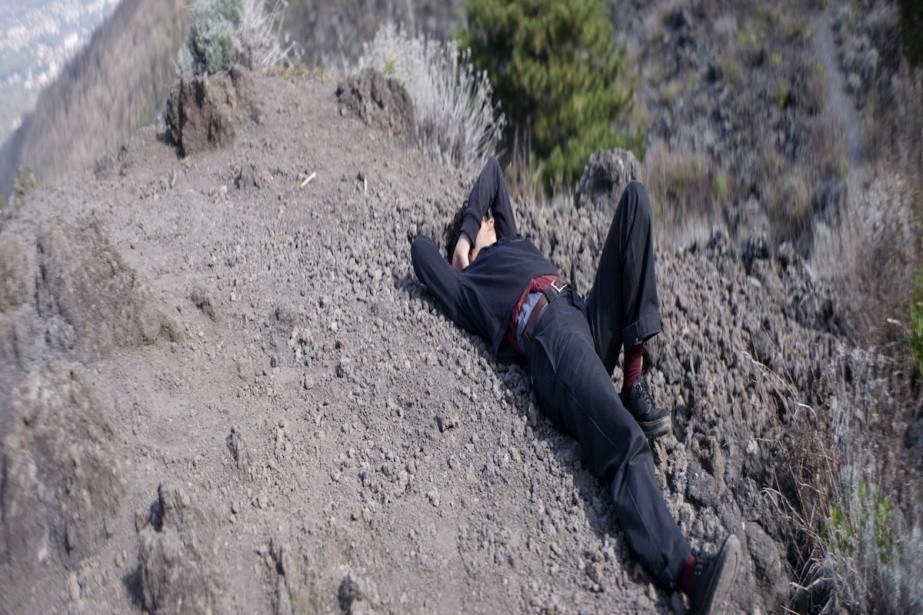
The exhibition features an expansive multi-channel video work that shows Moccia and her family mapping and walking sites in Naples and its surroundings, including the slopes and crater of Mount Vesuvius, the historical alleys of the city, the remains of factories on the seafront, and an abandoned NATO base. The non-linear presentation reflects the history of unsettlement and dislocation experienced by many due to various geological, militaristic and financial influences on the city over the past century. The work is co-authored with Moccia’s family members, who gave formal and informal contributions to the research, taking roles in planning the shoot, selecting locations, filming scenes and recreating gestures from archival photographs and films gathered by Moccia during her extensive investigation . The video is displayed on screens varying in scale and format from the storage of the gallery, both analogue and digital, showing footage filmed on a range of devices. Its overlapping, disordered format intentionally complicates embedded layers of cultural and societal nostalgia by unfolding through disjunction and accumulation rather than coherence or closure.
The film work is accompanied by large-scale sculpture formed from a fragmented set of aluminium casts, taking their shapes from the lava flows mapped from the Vesuvius eruption in 1944, while the city of Naples was under occupation from the US military during World War II. This decisive moment in Neapolitan history had direct effects on Moccia’s family, as her grandmother was forced to leave her home on the rural mountainside to emigrate to the city and marry. The sculpture is resolved in a state between collapse and reconstruction, reflecting an undetermined and involuntary emotional, social and cultural inheritance. Moccia proposes such alternative readings of nostalgia as a way of destabilising the narrative of progress imposed by global capitalist, far-right and neoliberal powers, and imagines counter-hegemonic alternative futures.
Rebecca Moccia’s recent exhibitions include Panorama, Pozzuoli (2025); Italian Pavilion, 15th Gwangju Biennale (2024); Galeria Madragoa, Lisbon (2024); Fondazione Sandretto Re Rebaudengo, Guarene (2023); Mazzoleni, Turin (2023); ICA Milano (2023); Jupiter Woods, London (2022). Rebecca Moccia is an inaugural PhD Researcher in Visual Arts and Creative Practices at Naples Academy of Fine Arts, and Co-founder of Art Workers Italia.
This exhibition is in partnership with Careof, Milan. Moccia’s new moving image work is produced by Careof, in collaboration with Temple Bar Gallery + Studios, Collezione Agovino, WHITESPACE Projects Napoli, Istituto Italiano di Cultura, Dublin.
Dublin 2
Tuesday to Saturday: 11am - 6pm Sunday: 12pm - 4pm