
Patrick Redmond: Facemaker
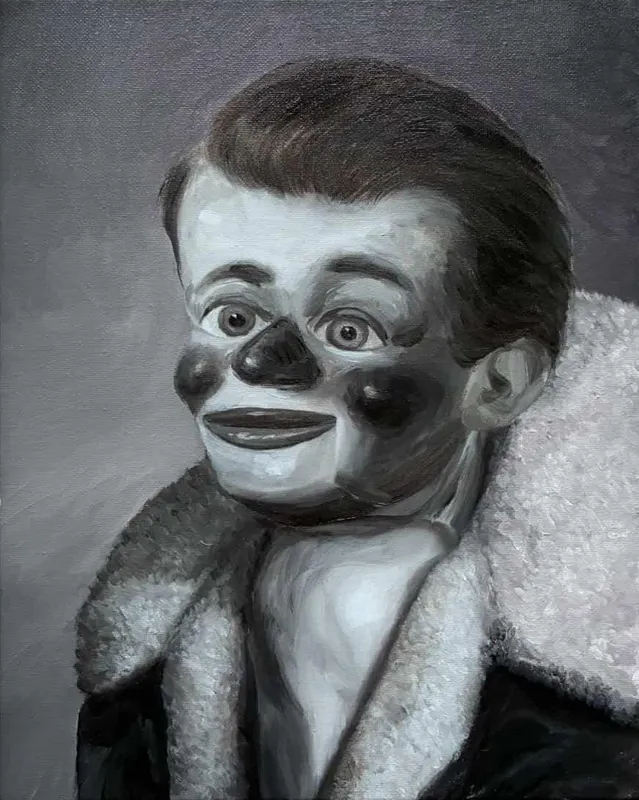
In his latest series of paintings, Patrick Redmond replaces individual subjects with ventriloquist dummies and mannequins, occupying an uncanny territory between object and person. Painted in monochrome, the works evoke classic studio publicity stills while quietly undoing their promise of charm and control.
Familiar faces become strange: fixed smiles, hollowed eyes, and subtly artificial expressions introduce an uncanny tension. The archetype of the 1940s actor represents an early model of the constructed public self carefully lit, styled, and shaped by powerful systems of image-making. The paintings reference archival photography and memory, emphasizing surface, contrast, and mediation. They are not portraits of individuals, but of images already distanced from lived experience. The addition of ventriloquist dummy features makes this distance explicit, turning metaphor into form.
For Redmond, ventriloquism displaces voice and agency: the dummy appears animated while another entity speaks through it, a dynamic that resonates strongly with contemporary life, in which identities are increasingly performed through curated images, avatars, and scripted personas. The frozen smile suggests the pressures of visibility and the expectation of constant presentation, where complexity and ambiguity are smoothed away.
By collapsing Hollywood’s past with present-day anxieties about authenticity and control, the series suggests that the performance of identity has not diminished but intensified. These portraits ask who is truly speaking today, and whether the selves we present are animated from within or expertly operated from elsewhere.
Patrick Redmond was born in Dublin in 1976 and studied at IADT, graduating in 1999. As well as seven previous solo exhibitions at the Molesworth, he has had solo shows at the RHA and the Hunt Museum. He was also included in the group show, Seen Not Heard, at the Crawford Gallery in 2019. Redmond lives and works near Gorey in Co. Wexford.
Some notes on the especial faciality paintings of the artist Patrick Redmond
by Jake Chapman
What is a face? What is a painting of a face? What is a painting without a face? What is a painting of a smiling face transformed into an uncanny mask? What is ‘faciality’ other than the unstable combination of all these elements thrown into disarray? The face is already a ventriloqual conceit, for all the squabbling significations oozing from its mouth and written on its rupturing skin. So why does the body (in its flailing panic) defer to the face as its prime representative? Why would the face draw attention to its chaotic masquerade? Is the face a map of the soul, perhaps? The puzzle mapped onto itself, since ‘a map is not the territory it represents, but, if correct, it has a similar structure to the territory…’ (Korzybski). The face-map is a self-hallucination that blindly negotiates its schematic unreliability as if its symptoms were unique – what is the beaming smile but an incriminating sign, and attractor for insecurity, the part-object-body crowned by the contradictory rictus grin? The body wishes the face to transcend its moronic anthropoid posture; even robots are blighted by this constraint: can a robot ever possess a face, or does it only deserve a mask? Even a lifelike face is a mask – true for robots and humans. A body holds its head up, offers it on a stick (the neck), it proffers it, and hides behind the face’s defacement, insisting that meaning is only contained in the face, nowhere else – the face fills up with blood, capillaries engorge to form a coquettish blush, before flushing its colouration away when sadness requires pallid sadness – exactly the two poles that Deleuze and Guattari discover inside the face’s own machinery: a ‘blank wall’ of signification, blank enough to take any inscription, and a ‘black hole’ of subjectivity where intensity gets sucked in and trapped. The mantle of sentiment often resides around the face, like fruit flies orbiting a rotten apple, but sentiment is only ‘homeless representation’ (Greenberg). As the innocent grin leers, the face, like Bataille’s animal is ‘in the world like water-in-water’. The surface on the face itself is unstable, sometimes raging like Mars, or turbulent like the weatherman’s idiotic face (which tells us that he despises the inaccuracies of his job, and is ashamed to be paid for his ineptitude); and think of the tangential corrupted planes of Picasso’s Weeping Women, the sizzling brutality of Bacon, or the malleable non-face of the Elephant Man hidden by a rough cotton sack… or is it a pillow case… think of Mr Potato Head’s Cubist promiscuity – there’s nothing irrational about these facial disfigurements since the face is always-already disfigured during the very moment of ‘subjectification,’ that is, when it opens its mouth, speaks, when it gapes, yawns, or offers an agonal gasp, or burp, and we, a willing counterpart, risk being sucked into the hole, into the alimentary system, down into the gut, passing through the bowels and ejected from the ‘wide open anus’ (Luther), there to begin it all again, like poor old Michael Finnegan whose mouth expels ‘chinnegan, pinnegan, in-again, din-again, thin-again and begin-again’. Our face reciprocates with a smile and our puppet hands play their part by protruding out to shake other available hands, the lips plant kisses on cheeks as they are offered, those juicy peaches, thus the intrapersonal social mingling goes on and on, endlessly duplicating, endlessly unconcluded. We can say The face is not a thing as such, but meaning’s fetishisation compounded in the form of a swollen lump of flesh planted on the frontal surface of a head, a tenderised capitulum, its raw nerves pinned to infinity: ‘cursed the ground where dead thoughts live new and oddly bodied, and evil the mind that is held by no head.’ (Negarestani). A cursed blob then, with peep-holes, small nostril-holes for air, and a hole-slit for the production of sounds, saliva and for the spread of infections, for the commodification of sweet and sour tastes, and the sucking or spitting out of experimental incorporations. The face then, is an ‘abstract machine’ (Deleuze and Guattari) insofar as it leers, gapes, sucks, gurgles, blinks, weeps and dribbles in order for its montage of effects to find their social corollary, to match other leering, gaping, sucking, gurgling, blinking, weeping, dribbling abstract montage machines. Thus to quell the panic, to match expressions – to make acquaintance – a smile exchanged for a frown, a laugh swapped for tears of joy: an intimate calculus of interactions, with bids for facial recognition, often badly timed, or misaligned – re-adjusted, but too early or late, since the masticating maw always wants more, being voracious for interaction, for chitchat, for love, so it chatters away, lips its licks, salivates. The world is its painful mirror, set before it with other prying faces forming matching approximations: ‘He moved his face closer to the glass, fingering the soft skin just below his left eye, dragging it down to peer into the glistening mess. He dipped his chin, tipped his head, turned it to the left and right, but despite this deliberate animation the eyes remained fixed, the reflected stare constant, the mask’s uncanny sentience disavowing all suggestion of a soul in the very attempt to catch sight of it’ (2 + 2 = 5). The mask is sometimes mistaken for the sinister petrification of the face, a face of death congealed in petrified form, petrified in time – but it is nothing compared to the fleshy face, nothing compared to the churning machination of distended bones that grind and contort its factory of grotesque expressions, like the baboon’s fleshy puce pink anus (which speaks no less clearly, no less articulately than a human face), or, for that matter, the expressive cholic of the child, saying: ‘we do not rush toward death, we flee the catastrophe of birth…’ like the mask ‘the real evil, is behind not ahead of us.’ (Cioran). The mask is a settlement made for the purpose of a molecular pacification, covering up the tightening torsional muscularity of the radiating face, as it wrings out its monstrous atomic expressions, as it leers at us from the surface of the painting, from the paintings the faces and its masks, captured in the especial faciality paintings of the artist Patrick Redmond.
Jake Chapman is a British artist. He formerly worked in partnership with his brother, Dinos, and was a leading member of the YBA group of artists.
Dublin 2
During exhibitions:
Monday-Friday, 10.30am-5.30pm; Saturday, 11am-2pm
The gallery does not open on Saturdays during the months of January and August or on bank holiday weekends.
Access: The ground floor of the gallery is accessible to wheelchair users and others with mobility challenges.